Saturday, January 29, 2011

The Reel Deal's Best of 2010

The 10 Best Films of 2010

1.) "The Social Network"

David Fincher has taken the repressed masochism of his 1999 “Fight Club” and transposed it to the elite WASP jungle of Harvard University and beyond. From its opening reel, we bear witness to machine gun barrages of dialogue between scripter Aaron Sorkin’s cold, calculating characterization of Facebook CEO Mark Zuckerberg (Jesse Eisenberg, never better) and a quasi-fictional girlfriend Erica Albright (Rooney Mara) that lure us in with cinematic smartassdom, then pull back to reveal stark undercurrent s of isolation and ambiguity. This tale of the founding of our most influential social networking website and its almost eerie pervasion in the state 21st century communication compels on all levels; the cast – Andrew Garfield, Armie Hammer and Justin Timberlake, among others – is uniformly excellent, their performances all the more intensified by Trent Reznor and Atticus Ross’ alternately propulsive and haunting ambient score.


* In the Blu-Ray package’s loaded making of featurette, Eisenberg muses on the frustrating but rewarding aspects of Fincher’s cryptic, “esoteric” mode of speak on set; it’s confirmed throughout the director’s feature commentary that this is no understatement. Still, the film’s bravado is undeniable, and makes the supplemental features satisfying and illuminating across the board. Widescreen format and 5.1 DTS-HD both pristine.  ★★★★★ (5/5)

2.) "Black Swan"

Multi-layered, sharply self-referential tale of artistic obsession that never shied away from flourish. The most sumptuous of Aronofsky's work to date, with a bravura performance from Natalie Portman. Review here.  ★★★★★ (5/5)


3.) "Toy Story 3"

Oddly existential and pure at heart. There's just something good about this one.
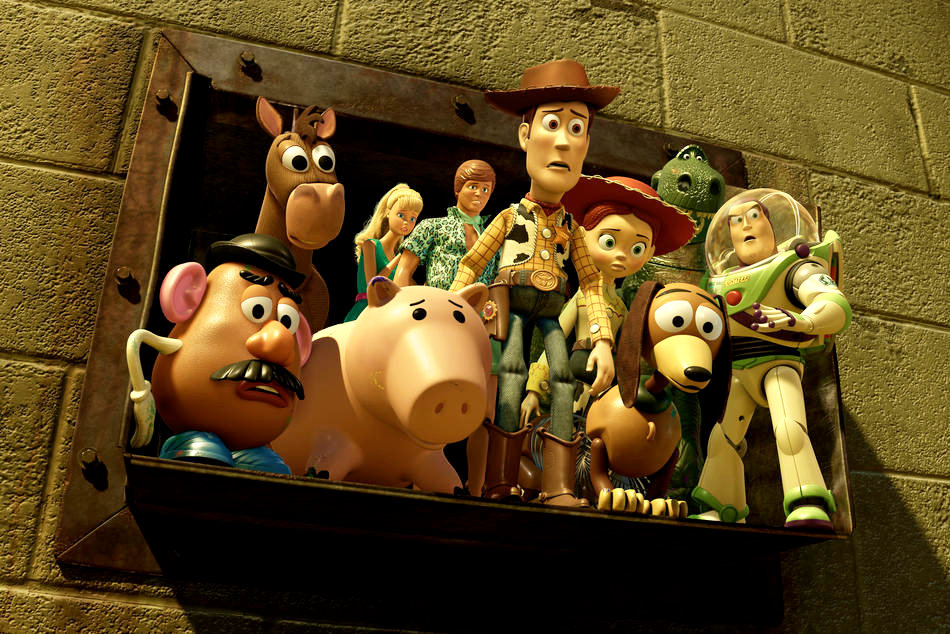

There are those moments (though not too often) when we sit in a theater and find ourselves in a collective harmony that's both refreshing, and, in a more reflective sense, lingering with a warm and fuzzy resonance that follows us out the door, even after the credits have rolled. I saw "Toy Story 3" with lifelong friends of mine. After we walked out, one of them began to discuss a younger brother's return to the careless summer months, and mentioned his lamenting the sudden shift from school lunches to sandwiches made at home. Before I could snap into that harder reflex of reality, the one that laughs off, dismisses and trivializes such concerns, something happened - we smiled. For those smiles, I hold "Toy Story 3"'s virtuous allusions to childhood wonder responsible.  ★★★★★ (5/5)


4.) "True Grit"

"True Grit" precedes its first moments with the Biblical proverb, "The wicked flee when none pursueth," and those words are echoed nearly the whole way through. Through the whiplash narrative of 14 year old Mattie Ross (Hailee Steinfeld) we are made known of the man who killed her father, Tom Chaney (Josh Brolin). Mattie's pursuing Rooster Cogburn (Jeff Bridges), her ideal choice for hire as an accomplice to her vengeance. LaBoeuf is pursuing Chaney over a murder several months prior.  "Lucky" Ned Pepper (Barry Pepper) and his gang are pursuing Mattie and Rooster in their own vendetta. Cat-and-mouse chase of a high order from the Coens by way of tight, gripping and poetic Western homage. ★★★★☆ (4/5)


5.) "Inception"

One of the boldest, ballsiest big budget blockbusters perhaps of all time, completely unafraid to stimulate the senses and challenge the intellect simultaneously. Review here.  ★★★★★ (5/5)


6.) "Let Me In"

"Let Me In" could have well been the words uttered by its writer/director Matt Reeves, in an appeal to justify having made a film (based on Tomas Alfredson's 2008 "Let The Right One In") both light and dark, frigid and warm, painful and touching - and yet not cut from a cloth entirely its own. “Let me in contention with that first film,”  Reeves’ adaptation begs us to consider, “or at least let me stand alongside it.” It's a request worth granting, though not only on the grounds of the film's visual style, which is also present in abundance.  Reeves' impulse to photograph his winter-bound mise en scène to present a tale of true androgynous beauty is chilling and mysterious, while still averting any tactics of manipulation to appease the salivating masses of sappy Twi-hard vamp admirers. In its universe exists no “Team Abby” (Chloe Grace-Moretz) or “Team Owen" (Kodi Smit-McPhee), but an intimate snapshot transcending romantic pretension and superficiality. ★★★★☆ (4/5)


7.) "Enter the Void"

French provocateur Gaspar Noe (Irreversible)'s "Enter the Void" opens with an AD/HD ridden cinematic kick to the gut, flashing lights so bold, bright and primeval they'd make even Kanye West blush. This is the director’s first test. Presenting us with all his simulated acidic hallucinations (at about 3 title cards per second), we understand just what kind of a trip we’re strapped in for, and can choose whether to enter with gleeful abandon, or simply stay clean and sober.


The filmic equivalent of "taking the red pill," Noe's vision is likely the most relevant portrait of aimless existence since "Boogie Nights," and a trip down a nihilistic rabbit hole all its own. Its take on life, love, sex, drugs and death (not necessarily in that order) is at times turn-offishly cynical, but its audacity lies in the presentation: it's a trip you can't stop from happening, whether you like it or not. This is powerful filmmaking.  ★★★★☆ (4.5/5) 


8.) "Exit Through The Gift Shop"

Docudramatic true story about how a single act of fanaticism can create - or be mistaken for - art. Enigmatic street artist Banksy's marvelous first film effort is as hilarious as it is perceptive, as it observes the growth of a modern movement, its most prominent figures, its run-ins with the law....and Thierry Guetta. To some, the filmmaker-turned-spray "artist" Guetta may be a national treasure, to others (including the street legends he once compulsively filmed) he's a slap in the face. As many continue to speculate street art's role as either important contemporary work or flashy gimmick, the questions the film raises about Guetta's own artistic worth in this "barely legal" cultural crusade are as relevant to this one man as they are to the movement itself.  ★★★★☆ (4/5)


9.) "Cyrus"

Any other director(s) than Mark and Jay Duplass might have made "Cyrus" a hackneyed screwball comedy. Any other actors than John C. Reilly, Jonah Hill and Marisa Tomei might have made it an indie dramedy too quirky for its own good. "Cyrus" doesn't sacrifice on either end, and the result is hilarious, weird and kind of remarkable.   ★★★★☆ (4/5)


10.) "Scott Pilgrim VS. The World"

Scott Pilgrim is that fragment of our psyches that allows our ID to trump our ego every time out.   Everyone around him seems certain he is in peril, yet Scott ignores this with reckless abandon, because he addresses the shortcomings in his life as a way of fueling his fires.  Film critic Elvis Mitchell described it during his interview with Edgar Wright on his radio show "The Treatment" as "slacker narcissism".


Finally, someone has captured that slippery persona of Michael Cera and allowed it to truly shine.  "Scott Pilgrim" is no prepackaged comedy "vehicle," it's the sensibilities of an apt director with the kind of infectious conviction that elevates material like this.  Consider one scene in which he is approaching a battle with two of Ramona's evil exes, the Katayanagi Twins (Shota and Keita Saito), Kyle and Ken respectively.   Scott stares off into space during his band's practice, as he plucks at his bass into the void that is his quietly reserved, laid back mania.  He then assures his lead singer Stephen Stills (a grungy, exuberantly dopey Mark Webber), "I play better when I'm in a bad mood." Scott finds himself amidst one hell of a love triangle, and its participants teeter that fine line that boyfriends, girlfriends, exes, friends, lovers, often do.  The movie looks at its subjects as people caught in the messy cross-woven webs of their courtships as a game, and is it ever. Edgar Wright's film is probably destined to stay contained in its cult following without much cross-over, but the performances (particularly Winstead's and Wong's) will catch anyone off guard, and its core is endearingly sweet.  ★★★★☆ (4/5)


Underrated


"Frozen"


The first film to force this jaded lover of horror to physically recoil during its running time. Adam Green's blue and white palette accents "Frozen's" potent horror cocktail - blue-collar story blended with white-knuckling anxiety - as much as it does its ominous winter backdrop.  The film reels in the terror through subtlety, amped up insanity and the power of suggestion - each equally effective as the next - without ever condescending to Dan (Kevin Zegers), Joe (Shawn Ashmore) or Parker (Emma Bell) in the midst of their predicament. These three are witless teen archetypes, yes. Do these kind of people actually exist? Yes.  On a first viewing, submit yourself to this one and prepare to be drained. On a second, show it to friends and watch them lose it.   ★★☆☆ (3.5/5)


"The Last Exorcism"

A nasty, deceptive, superbly crafted little film.  Well, actually, between the dogged promotion of producer Eli Roth and the sweeping implications of its final moments, it's not a little film at all.  Yet it is ingenious in the way it manages to feel so small, so isolated when stripped down its bare essentials, which are completely obvious in retrospect, but concealed with a sinister platitude.  ★★★★☆ (4/5)


Honorable Mention: "Dogtooth", "The Fighter", "Shutter Island"


Wednesday, December 8, 2010

Fangoria #299

Since my entry into the FANGORIA staff in late August, I've been nothing short of ecstatic to be covering the beat of the melding of class and trash, sleaze and beauty more formally known as the horror genre. FANGORIA #299 is now on shelves, with a cover story dedicated to Darren Aronofsky's "Black Swan." The magazine has been making some incredible strides and interesting revamps, some completely fresh and others returning back to cherished and seemingly (though only temporarily) lost roots.


In addition to an in-depth look at Aronofsky's psycho-thriller, horror fiends will also find set coverage of Jim Mickle's "Stake Land," a nice look at Sage Stallone (son of Sylvester)'s adamant revival of Grindhouse Releasing, an interview with French auteur Jean Rollin, and can find my review of the recent Aussie creature feature "The Dark Lurking" at Dr. Cyclops' Dungeon of Discs.

"Black Swan" (2010)

  Darren Aronofsky's "Black Swan"never once reveals exactly what it is, which is ironic. The film's wildly unrestrained psychosomatic narrative is devoted to subjectivity, free to romp in artistic grandeur, though it's crafted around one calculating, rigidly disciplined performer who can't allow her mind to be free for a second. The young woman is Nina Sayers (Natalie Portman), and her passion and elegance is apparent as we observe her daily routine - her walk from the humble apartment she shares with her loving, if not coddling mother (Barbara Hershey) to her New York City ballet company, run by one formidable director Thomas Leroy (Vincent Cassell). It is here where Nina will thrash out the limbering precision of her dance regiments, in preparing for the company's production of Tchaikovsky's Swan Lake, for which swarms of students covet the lead of Swan Queen. Leroy acknowledges that the ballet has been done ad nauseam, but this time it's going to be "stripped down, raw, visceral;" "Black Swan" brilliantly encompasses the concise leanness of Leroy's approach along with its sinister facets that lie beneath.

  It is nominally a hybrid adaptation of Dostoyevsky's novella The Double and Michael Powell and Emeric Pressburger's 1948 balletic opus The Red Shoes, yes, and how paranoia and competition can dwindle away at the most committed of minds under the portent of pressure. But just as Rosemary's Baby - a seminal film for Aronofsky which the director publicly cites to be of major influence - was less concerned with the occult than with the perils of invested trust, so too is "Black Swan" devoted to greater thematic layering. It is a fascinating portrait of obsession, a film that sees the disturbing hum of anxiety in the physical manifest - thus the players in this gorgeously twisted world become slaves to the life-long audition from which they cannot escape.

 A cunning balance of seduction and sweetness with unsettling repulsion, "Black Swan" works effectively as dynamic melodrama before taking a wicked turn into Cronenbergian horror-fantasy. Natalie Portman anchors this expertly as the fragile, innocent young talent navigating her way down the darkest corridors of sexuality and the looming threat of failure. Nina is suffocated by the expectations of all those around her to embody both the White and Black Swan - the former being her perfect match, the latter evading her grasp. That she is challenged for the dual role by the presence of a more naturally "free" Lily (Mila Kunis) only accelerates the rapid pace of her fears, which soon begin to surface skin deep.

  Empathy for Nina might have been hard to find in a world this insular, but Portman's fearless performance along with the same knack for minutia and realist grit of Aronofsky's 2008 The Wrestler allow the material to transcend in a lavish romp that begs us to surrender to its dazzling visual splendor. Hand in hand with Aronofsky's apt study of the athleticism of the human body, we observe Nina's identity slowly begin to rear its freakish, other-worldly head - only to snap back with lightning speed to the hallucinatory discovery of her bodily desires.


  Two minor female roles - Hershey as Erica Sayers and Winona Ryder as womanizing Leroy's former "little princess" Beth Macintyre - cleverly craft the picture's lingering tales of the original story's traditional "dying swan" element without relying too heavily on overt plot points. Both women, in their jealousy and obsession to live vicariously through the ballet that offers Nina the ideal career, underscore the political tensions that come along with any modern backdrop of competition. Erica listens and supports, but pushes and antagonizes once too far, while Beth's long-gone days as Swan Queen remain all too foreboding of Nina's hellish descent into madness.

  As we check in and out, along with Nina's mind, to the internal, hushed sounds of buzzing audiences, the picture lulls deeper into absurdity, and by the third act the film asks us to check all rationale at the door. Though in this case, the sensationalist flair with which Aronofsky crafts "Black Swan"'s final choreography sequences (gorgeously staged by Benjamin Millepied) along with frequent collaborator Clint Mansell's masterful arrangement of Tchaikovsky's original score make the stunning rite of passage all the more poignant, never bordering on potential camp territory.

  "Black Swan"'s ability to polarize audiences will ultimately lie in how its maker's utter disregard for restraint or conventional form will sit with those on the receiving end. It is a film that refuses to sit still and commit to certainty, but in this case that's hardly a criticism. The tragedy of Nina's blind ambition will remind the film's lovers and detractors that perfection, if it can be reached at all, cannot be reached without a leap of faith.

★★★★ (5/5)


Cast & Credits

Nina Sayers/The White Swan: Natalie Portman
Lily/The Black Swan: Mila Kunis
Thomas Leroy/The Gentleman: Vincent Cassel
Erica Sayers/The Queen: Barbara Hershey
Beth Macintyre/The Dying Swan: Winona Ryder

Fox Searchlight presents a film directed by Darren Aronofsky. Written by Mark Heyman, Andrew Heinz and John McLaughlin. Running time: 108 minutes. Rated R (for strong sexual content, disturbing violent images, language and some drug use).


This review originally published in Vol. 90, Issue 13 (Dec. 9, 2010) of The Montclarion

Monday, September 6, 2010

"Centurion" (2010)

   Neil Marshall's "The Descent" was about a group of friends who lived to take risks, and were proud of them - yet they either never lived to tell their tales, or wouldn't dare speak of them after they had survived.  Here is his latest, "Centurion", which is about the legendary Ninth Legion, a group of men who risked their lives in great peril every day, and again not much of anybody knew of the dangers they faced, nor the value of their lives.

  When "Centurion" opens up, we meet Quintus Dias (Michael Fassbender).  He's the sole survivor of some vicious raid by the Picts, the only group more savage and gruntingly brutish than his own legion.  There is some introduction after the film's opening credits - complete with what's probably best known in epics as the "helicopter introductory nature shot" - whose job is to create the illusion that what's going on here involves some kind of high stakes.  "AD 117.  The Roman Empire stretches from Egypt to Spain, and East as far as the Black Sea".  Already, the obligatory historical rundown that prefaces such a stripped down film feels out of place, trailer-ready to pander to a formula that had me wishing for more of Marshall’s unrelenting claustrophobic horror, rather than his pre-occupation with displacing it in ancient middle Earth.

  Then again, there are two arguments for and against the  historically prolific accessories known as "swords and sandals", and taking a pro or con stance ultimately will depend on what you value more:  the part that's historical, or the part that's prolific.  Return to a swords-and-sandals epic and you will find yourself in all too familiar territory:

  One man - decidedly of militaristic importance and stature - lies in the center of clashes of violent dispute in ancient Rome, then finds himself torn apart by captivity, love triangles of messy sexual tension, and a moral quandary that could probably make dying on the battlefield a pleasing, more convenient alternative.

  He also presumably holds his base of knowledge of the genre within the confines of those tired Roman soldier films - among them "Gladiator" and "300",  - which some I imagine will find to be homage with an adept level of respect.  What "Centurion" is, is an exercise in style that recycles what it perceives to be authentic, and that becomes sort of hit or miss.

  To start, Neil Marshall approaches his mythology with the same kind of awe and curiosity a kid staying the night at a friend's house telling a local urban legend has.  In that way, it's hard to resist.  One great shot of the Legion in battle sees flaming boulders closing in from every which way, mirroring that smothering paranoid feeling Marshall managed to get from those caves in "The Descent". 

  Marshall clearly understands that what we can conjure up in the darkness of our imagination - whether that's a vicious throng of monsters at the bottom of an unexplored cave, or a troupe of Roman soldiers whose fate is swept of recorded documentation - is most compelling when placed in a fragment of reality; the journey of backpacking young women or the waging battles of the vast Roman empirical struggle.   Where the film falls flat, is when that aura within the context of historical legend becomes essentially removed, replacing something so potentially rich in lore with highly stylized limb-hacking choreography.  Translated into horror, that paranoid hysteria is most effective when unexplained, but in “Centurion” the action begs explanation.

  The film's strictly black and white characters also have a curious way of glossing over anything reminiscent of real dimension.  Many of them, including Roman-epic veteran Dominic West as General Titus Flavius Virilus (there’s a mouthful) act as pawns in some cruel game rather than human beings.  Marshall no doubt relished in the opportunity to dress down, ugly up and make a brute out of Olga Kurylenko, here playing Etain, the merciless and deaf Pict warrior whose makeup looks plucked out of a missing Joel Schumacher “Batman” installment.  We’re told at some point that her motive is vengeance on behalf of her murdered family.  I had trouble seeing more than the anger and brooding called for in an almost entirely silent and wasted role.

  What I found myself repeatingly asking was a matter of the great moments that could arise out of a story willing to report unwritten history.  Was every Pict simply a ruthless sadist?  Every Roman a man of honor and glory?  Where are those Romans whom secretly despised the civilization that forced them to fight to fatten their emperor, instead of blindly obeying it?  When will we see a movie about them?  Or maybe with "Centurion" we have, we just haven't seen it illustrated in any way beyond ancient Roman, swear-injected fraternizing and the bonding through their bloodshed that’s become so commonplace in a marketplace dominated by the interests of the modern bro-dude’s Facebook page.

  The film's Video-On-Demand offering - compatible with video game consoles Xbox 360 and Playstation 3 - illustrates pretty clearly the audience Marshall's film will be tapping into.  Sure, some pumped up, avid gamers hooked on a role playing game like God of War would likely enjoy taking a break from their game-play to download it on their consoles and watch it re-enacted, and "Centurion" is a well made representation of its own cornered genre.  It is lean, concise fare whose business is fetishizing brawny, overbearing male archetypes and their exploits, which mainly consist of pillaging, mutilation and total conquest.   My question watching was, didn't we just get all that playing the game?

★★☆☆☆ (2.5/5)

Cast & Credits

Centurion Quintus Dias:  Michael Fassbender
Commander Gratus:  Andreas Wisniewski
Vortix:  Dave Legendo
Aeron:  Axelle Carolyn
General Titus Flavius Virilus:  Dominic West
Etain:  Olga Kurlenko

Magnet Releasing Presents a Film Written and Directed by Neil Marshall.  Running time: 97 minutes.  Rated R (For Sequences of Strong Bloody Violence, grisly images and language).


You can find this review, its supplemental materials, as well as other extensive film coverage at EInsiders.com.

Tuesday, August 24, 2010

"Piranha 3D" (2010)


  Delivering his review of Wes Craven's "New Nightmare" in 1994, the late film critic Gene Siskel expressed his disdain for the film's core, dismissing it as "just an excuse to have the same old blood letting".  Siskel's words - when placed in a certain context - might of course resonate with a review of "Piranha 3D", but where he once found fault is precisely what's to love, and so with some consideration, I'll rephrase the spirit of his lament, by saying that French director Alexandre Aja's exploitative rehash of the 1978 Roger Corman produced "Piranha" is reason, very good reason, to dive into the blood letting.

  "Piranha 3D" works and delivers on two effective levels that create an awesomely nutty communal movie-going experience, one that only be described as either gleefully over-the-top or some of the most hilarious deadpan humor in recent years, or both.  Aja is making a conscious effort to evoke response with his blood-spattered ice cream sundae, and much fun is to be had amidst the vast array of "Holy Sh-t" moments the movie throws at high speed.

 The film also understands the more novel origins of 3-D, and here it chooses to make unabashedly gratuitous use of its gimmicky gags, almost as if to poke fun at the fact that they're otherwise needless in the cinema altogether.  One girl has one two many shots of tequila, so naturally we get 3D vomit off the side of a boat.  An obligatory party guy douses us with the foam of a keg.  The women are gorgeous, decadent and free-spirited so 3D full frontal - and rear - nudity is what we get.  It's "Piranha 3D"'s boozy 80's horror/sex comedy allusions like these that are not only refreshing in the context of their usage, but also deepen my appreciation for the movie's ability to value the other films its modeling, rather than mock them with the tired pretense that it's just "so bad it's good".

"Piranha"'s rather apt and clever direction is more concerned with the vapid plights of its pitch perfect cast without relying too much on plot, which is kind of irresistible.  There's Elizabeth Shue as Lake Victoria's rhinoceros-skinned  local sheriff Julie Forester, and the great Ving Rhames as  her equally badass deputy counterpart, Fallon.  The "wild, wild" gratingly sleazy misogynist pornographer Derrick Jones (Jerry O'Connell) seems to be sending up - or paying homage, or doing a variation, take your pick - of the greater portion of O'Connells catalogue of roles as which works just right.  Adam Scott as Novak and Christopher Lloyd as Mr. Goodman who rope in the essence of this slum-show, with the kind of hammy acting Mickey Rourke tried for in "The Expendables" with no supporting beams.  Even Eli Roth steps in with gleefully silly lightness to emcee a wet t-shirt contest.

  Steven R. McQueen is at the center of it all as Jake, and is absolutely lifeless on screen; the movie knows this most of all, and virtually mocks the idea of real acting in a movie about crazed cannibalistic fish invading spring break.  Whether this is intentional to the credit of director Aja or simply happenstance I'm not exactly sure.  One almost feels like Jake's wholesome obliviousness was plucked from someone like Lawrence Monoson's Gary from the 1982 cult film "The Last American Virgin", though with a slightly more slanted edge of amorality.

  "Piranha 3D" places itself at a patient ease with its intoxicating B movie quietude, and does a pretty good job of maintaining a sense of calm before the blood bath ensues.  For a stretch, the hordes of piranhas roaming the depths of Lake Victoria are obviously deadly, but relatively non-threatening; their predatory killing instinct is first revealed in slasher "one-by-one" convention, beginning with Richard Dreyfuss as a man who bears no name, though we understand it's Matt Hooper when he's seen drinking a bottle of Amity Beer.

  Most importantly, "Piranha 3D" knows exactly what it is, and after we've gotten a taste of this town of caricatures - this movie goes for it.


  The crowd of Spring-Breakers remains blissfully naive, hedonistic, and ignorant to their surroundings.  I seriously doubt this was a post 9/11 socio-political commentary, but it very well could have been, sans wet t-shirts, horny co-eds and the incessant pumping of Benny Benassi mixes.  Their hijinks shamelessly set the stage for one of the most fiendishly absurd gorefest massacres put on screen in recent years.  Aja's use of obsessively detailed practical effects in collaboration with Gregory Nicotero and Howard Berger on the multiplying mortal wounds is admirably apt; the scene itself surpassed "Kill Bill Vol. 1"'s record for most gallons of fake blood used in a film, and it makes "Saving Private Ryan" look like "Dora The Explorer".  While that may sound disrespectful and dismissive to the serious attention that World War II movie deserves, it's the same kind of attitude these hapless dimwits would have had toward anything solemn at all.

  And so they die their horrible deaths, and we laugh in shock and awe.

★★★★☆ (4/5)


Cast & Credits

Richard Dreyfuss:  Matt Hooper
Ving Rhames:  Deputy Fallon
Elizabeth Shue:  Julie Forester
Christopher Lloyd:  Mr. Goodman
Eli Roth:   Wet T-Shirt Host
Jerry O'Connell:  Derrick Jones
Steven R. McQueen:  Jake Forester
Jessica Szohr:  Kelly
Kelly Brook:  Danni
Riley Steele:  Crystal
Adam Scott:  Novak
Ricardo Chavira:  Sam
Dina Meyer:  Paula
Paul Scheer:  Andrew
Brooklynn Proulx:  Laura Forester

  The Weinstein Company Presents a film directed by Alexandre Aja.  Running time: 89 minutes.  Rated R (Sequences of strong bloody horror violence and gore, graphic nudity, sexual content, language and some drug use).

Friday, July 23, 2010

"Life During Wartime" (2010)


  There’s a lot of talk of the humanization - or lack there of – of the monsters that pervade the mainline of the outside world in “Life During Wartime”, the new film from director Todd Solondz. The director first made a name for himself by branding absolutely no subject too taboo to hold under his microscope of twisted humanity, gauging every topic from the overlooked sadism of middle-school adolescence in “Welcome to the Dollhouse” to the ambiguous, dark and sometimes hilarious corners of sexuality in “Happiness”.  Both films maintain a certain level of mastery that solidifies credibility.  Shot with an eerily humane blindness to objectivity accompanied by patient, steady pacing and razor-sharp wit, Solondz has uniquely pastiched portraits of socially distorted losers and misanthropes, whose richly dimensioned presense haunted us long after their journeys into perverse self-fulfillment.  One does not go into a Todd Solondz film in the hopes of participating in some misty-eyed road to redemption. 
 
  His latest ranges from the usual dark, closeted suburban observations on everything from rape, pedophilia, suicide and murder, though on this particular outing, Mr. Solondz is scaling interests the director himself described as “a little more politically overt”. Here he places themes of forgiveness and emotional fortitude against the backdrop of a post-9/11 sense of paranoia that seems to have taken hold of the three sisters Trish (Allison Janney), Joy (Shirley Henderson) and Helen (Ally Sheedy), and the rest of their family, comprising a microcosm of neurosis and dysfunction.

  A sound understanding of the color spectrum, from black to white, might be a basic operating principle that ought to be in place when dealing with themes of this magnitude. There is a strength of unpredictable fluidity from Solondz’s relationship with that color black - known commonly as the only shade with utter absence of color - and its adverse white, the collective blending of all colors, one that shocks, rattles, astounds and even caps off its defining moments with some troublesome humour. In this context, these colors would allude to the obsessive intricacies of their respective characters, like some depraved subjects of a pulp-filled cartoon. What made "Happiness" so swift in its movement was its observation of the ways one operates when in a state of sexually arrested development, and its horrifying revelation of how these people maintain superficial acceptance in a society fixated on certain accepted levels of so-called "normalcy".  The result is often hilarious, but also fundamentally sad.

  “Life During Wartime”, which presents itself more as a follow-up variation than a sequel to the 1998 masterpiece that is “Happiness”, knows no such bounds, and forgets that this blend of restless black void once served a purpose in compelling those who watched to embark down unsettling, yet fascinating corridors of empathy. Here, Solondz’s formula has been watered down to a tactic that is gapingly less effective: Just how much dysfunction can we follow, and how unnerved will it render us?

  Our revisitation of the Jordan family brings us to their newly settled home in Miami, where the offbeat peculiarity of this closely-knit bunch now seems to exist as one big parody. Trish (originally played by Cynthia Stevenson) and Joy (played by Jane Adams in the 1998 film) have found themselves again in their usual trappings.  Trish begins a courtship with Harvey (Michael Lerner), a man whose Jewish blood, professed connection to Israel and gentle sincerity give her comfort she feared she may have lost ago; "You're so...normal!", she says.  Joy continues to be haunted by an old boyfriend Andy (Paul Reubens) who's long since committed suicide, but still can't seem to let go of his lingering resentment.  If not emotionally, she at least seems to be weakened down here by starvation.

  There is implication that their search for male companionship is some bi-product of the effect of their sour sexual and marital experiences.  But most of that melancholy is feigned this time around, and exhausted nearly to death with the same stomach curdling blend of static communication that played so fresh in Solondz's original effort.  In one bit of the film's opening dialogue, Trish has a frank and explicitly sexual conversation with her son Timmy (Dylan Riley Snyder, in an incredibly precocious portrayal), whose naive concern for the mysteries of life begin to ruminate with his Bar Mitzvah ceremony approaching.  For an exchange intended to illicit humor, the nature of this such scene has an adverse effect on its humanistic commentary, and the result becomes a disappointing exercise for those who might have been quick to excite over something as stalely cynical as this mock-shock-gag expo, described as a worthy companion piece.  While Solondz's eye for this kind of exchange in borderline repulsion was so keen in "Happiness", "Life During Wartime" has decided to recycle what cannot appropriately be transposed, as the film begins to objectify the crises of its decidedly ill-fated characters.  It's a shame, since they are - after all - a lost bunch of people, so obviously struggling with a considerable amount of angst.

Then there's the men.

  The male characters in "Happiness" haunted us with a resonance in their passive aggressive disconnection.  Bill Maplewood, played originally by Dylan Baker in arguably one of the most noble and uncompromising performances of the last twenty years, certainly gets a transformative revamp here.  Ciaran Hinds, now in the role as the psychiatrist pedophile who shattered the lives and stability of his family years earlier, starts on a path to reunite with his son Billy (Chris Marquette), who is now at college, and now suffering the ramifications of traumatic stress that his father so consciously and tragically embedded in him.  The culmination of that journey, however, feels rather insensitive to the events that preceded it, and ends on a note that's actually a little offensive given its circumstance.

  I acknowledge that "offensive" is a slippery description of a film that features a pedophile in one of its leading roles, and perhaps I've overextended my critique of a black comedy. Hinds does, as all the actors do here, give a fine performance.  And this is a film about forgiveness, right?  Still, what can't be shaken is the feeling that "Wartime" depends on the bizarre humane window of "Happiness" as a crutch while diminishing that effect, and the material simply can't support it.  One pivotal encounter speaks for itself:

  Hearing a knock on his college dorm room door, Billy answers the door to find his father standing there, waiting for him.  After letting him in, they engage in a discussion in which Bill questions, extensively, his son's sexual nature.  What follows - a disclosure that his son does not have rape fantasies as his father does - suddenly turns into a line of questioning as to whether or not Billy is gay, and the question's response ("No") is met with a smiling sigh of relief.


If he grew up a pedophiliac rapist like me, Bill seems to say, well I'd have someone to relate to.  But at least he's not gay. *Pfhew*.

  Solondz's ambitions to wrestle with themes of forgiveness are admirable, specifically the juxtaposition of intimate family dysfunction and trauma in a post 9/11 world.  But the film lacks the nerve to handle these characters with the compassion that "Happiness" granted, the compassion they deserve.  Instead, a boy without a father works towards false absolution.  Should he be?  If Timmy forgives a father he cannot respect, who isn't there, how can he possess the capacity to forget?  Or does he (like the film he's stuck in) just give him a pass?  Revisiting these characters becomes sickly, frustrating and, well, unforgiving.

★★☆☆☆ (2/5)


Cast & Credits

Joy Jordan:  Shirley Henderson
Allen:  Michael Kenneth Williams
Trish Jordan/Maplewood:  Allison Janney
Harvey Wiener:  Michael Lerner
Timmy Maplewood:  Dylan Riley Snyder
Bill Maplewood:  Ciaran Hinds
Andy:  Paul Reubens
Mona Jordan:  Renee Taylor
Jacqueline:  Charlotte Rampling
Helen Jordan:  Ally Sheedy
Mark Wiener:  Rich Pecci
Wanda:  Gaby Hoffman
Billy Maplewood:  Chris Marquette

IFC Films presents a film written and directed by Todd Solondz.  Running Time: 96 Minutes.  MPAA Rating:  No rating.


You can find this review, its supplemental materials, as well as other extensive film coverage at EInsiders.com.

Wednesday, July 21, 2010

"Inception" (2010)

Leonardo DiCaprio and Ellen Page peer out onto the shore of the subconscious.  Inception, 2010.
  Imagine Christopher Nolan as a child building sandcastles not unlike the structures in "Inception". Then he destroys them. What he does next is unclear, but I'm certain that before he arrives at that conclusion, he wonders how he built it and what made him destroy it, and that's what fascinates him most.  It's as if the flourishing labyrinths he constructs have never had destinations at all.  Instead, they open reflexive doors that demand exploration.  I doubt Nolan's characters have heard of pre-determinism a day in their lives.  And not since Quentin Tarantino emerged to helm "Pulp Fiction" has a filmmaker been so pristinely clear about the rules by which the dimensions of those characters operate.  Christopher Nolan knows his universe, and guides us through it more as a host than as a writer-director.

  To explain the plot of "Inception" is pointless.  Such an exercise would be like trying to explain someone how to work a Rubick's Cube, rather than just allowing them to navigate it for themselves, discovering as they go.  It is the film's composition, its design, and ultimately its apt ability to evoke response that is infinitely more important. Some may find it laughable. Others will be quick to dismiss its dialogue as shallow minded psycho-babble.  Those in admiration will incessantly pluck through its questionable holes in continuity, obsessing over arguments for something more tangible, more lucid. The objections one may have can only stem from either love or hate. Such is the mark of filmmaking of a high order.

  "Inception" is a deftly blended cocktail of noir and surrealism, pulled off with the conventions of an action thriller that gives dreams a life that is both metaphysical and rich in its enormity. One of the film's secrets is the way in which it avoids giving its guiding vessel, Dom Cobb (Leonardo DiCaprio)'s journey one particular purpose. The lengths Cobb will go to attain catharsis are the only inklings he has of a compass. The weight of his conviction is measured by bold and breathtaking physical feats, instead of hand-delivered motivation, or "plot points".

  I have read some criticisms of Nolan's sculpting of this kind of literal dream-scape construct as a negative, and understand where one might find it too objective.  I do not believe in literal confines within narrative as being equated with literal-mindedness, and found it to work for me. With ways in which Cobb describes the depths of dreams he and his team set out to raid, I am reminded of a recurring action sequence from the James Bond franchise - in which Bond scales the outside walls of buildings with a harness and bungee cord, with some delicate determination to infiltrate. In a sense, this is Nolan's own Bond movie, and Cobb is his super-agent.

  Descending, then reascending projections of reality, the subconscious mind, paradoxical occurrences and dreams within dreams manage to keep us in the present of each moment that holds this balance at stake, and translate what could be lost in pseudo-philosophy into compelling adventure. The film invites us to play a game that raises fundamental questions of existentialist dread, while confronting them as the characters do, through classical staples of the great heist and crew-oriented films like 1969's "The Italian Job" or Spielberg's "Munich".

  The pieces to such a game are elaborate, but not without necessity. There is an assembling of Cobb's team that calls into play several members, all with a crucial importance. Their assignment - to perform inception, the covert implantation of an idea in one's mind to pass it off as that person's own idea - becomes fluid with the introduction of associate Arthur (Joseph Gordon-Levitt), Eames (Tom Hardy), Yusuf (Dileep Rao), a chemist, and the newly recruited Ariadne (Ellen Page).

  At first I found myself asking why Cobb remained explaining the nature of their dream navigation in such consistent fashion, almost ad nauseam. Then it occurred to me: he's rationalizing this world as he goes, perpetuating the process of this continuous, unraveling one man.  Cobb's brooding over wife Mal (played with haunting grace by Marion Cotillard) intertwines an emotional output that furthers the growth of this obsession with each devastating circumstance that rifts in time.  DiCaprio has solidified his status as our generation's leading man, while adding ink to the stamp he has now made for himself as a purveyor of films dealing with psychological turmoil.  It's a mark he can bear proudly.

Dom Cobb (Leonardo DiCaprio) plunges into his inner depths.  Inception, 2010.

  All actors bring incredible range and a subtle sense of discovery to their roles.  The character of Ariadne is a fascinating complement to Cobb in a similar respect, with her role as "architect" in their grand scheme sharing this constant discovery with his fiendish self-exploration.  The always fresh Cillian Murphy, as Fischer, a young corporate heir at a crossroads of identity is again inspired in his role.  Fischer's final meeting with a father with whom he has always been at odds plucks at hues of sadness, shame and self-doubt, which is met by a triumph of discourse and humanity.

  Joseph Gordon-Levitt as Arthur is another expertly played performance of straight-forwardness.  At times, he evokes the supporting and balancing sincerity of Robert Duvall's consigliere Tom Hagan in "The Godfather".  Levitt's performance is always quietly calculated, with subtle mediation.  He provides Dom and all those roped into his anxiety-ridden roller coaster with a sense of gravity that allows them to recollect themselves, while setting the film's pacing at ease.

   I'll run the risk of stealing the title from a song by Jason Mraz when I say that "Inception" commands the powers of its cast with the dynamo of volition.

  I have not met Christopher Nolan, and I have yet to hear him speak extensively about "Inception", as it was, as always, my prerogative to maintain a clean slate before absorbing the film.  I do feel, however, that I know something about him.  I know he believes in this construct of dreams he has created, in the same way Machiavelli perceives the world to be able to be condensed in a blueprint of conduct and decisiveness.  I know that he is a man who is unafraid - without hesitation - to make films that exercise his relentless affinity for self-discovery, however dark or unfulfilling it might be.  With "Inception", I think he has reached some level of fulfillment.

  The essence of Nolan's vision could have likely drawn inspiration from the surrealist, paradoxical art of M.C. Escher, those mirroring echoes of deep-seated torment.  Wally Pfister, a collaborator with Nolan dating back ten years ago in 2000's "Memento" deserves an Oscar nomination for his piercing cinematography, which inspires awe on the shores of our most primal human fears and dreams, literally and figuratively.  There is a virtuous motif of a spinning top Cobb keeps nearby that is perhaps the most meditative of all of the director's iconic staples, more so even than the twisted philosophy of the anarchic Joker in his "The Dark Knight".  To follow its presence as you watch, is to succumb to a seduction that harnesses universal principle.

M.C. Escher's Drawing Hands, 1948.

   "Inception" can be viewed as a thorough massaging of the senses and a cerebral fantasy, although Dom Cobb is completely unaware of the existence of such make-watch-easy labels, which enriches the performance leaps and bounds.  Its special effects are never exploited, but brushed over the film's ideas and notions with the faith that they'll stick.  They are astonishing not so much by way of flashy demonstration, but in the way they are transposed, fixated on and revealed.  The misconception of the film as a sci-fi shoot 'em up picture is an unfortunate communication breakdown, with advertising campaigns at the center of responsibility.

  Make no mistake:  this is a film withheld by no boundaries or contrivances.  It's for anyone with a sense of marvel, who still yearns to take flight on their own terms.  And for those who continue to challenge what we should accept as we inhabit the world, as each day passes.

  Nolan's script contains what he understands to be true, designs it in abstraction and holds it to that standard, sending it all the way home.  The film will also prove that virtually none of my review can encapsulate experience, only project it.  I bear in mind that it is July, but for now, he has crafted the most captivating achievement of 2010.


★★★★★ (5/5)


Cast & Credits

Cobb:  Leonardo DiCaprio
Saito:  Ken Watanabe
Arthur:  Joseph Gordon-Levitt
Mal:  Marion Cotillard
Ariande:  Ellen Page
Eames:  Tom Hardy
Robert Fischer, Jr.:  Cillian Murphy
Browning:  Tom Berenger
Miles:  Michael Caine
Yusuf:  Dileep Rao
Maurice Fischer:  Pete Postlethwaite

Warner Brothers presents a film written and directed by Christopher Nolan.  Running time:  148 minutes.  MPAA rating:  PG-13 (For sequences of violence and action throughout).